The rally in precious metals illustrates two defining features of trend following: a dynamic long-short approach to markets and dynamic position sizing.
A broadening rally
Precious metals have been among the strongest-trending markets of 2025. Gold led the way over the first half of the year, and uptrends in silver, platinum, and palladium have since gained momentum, reportedly as investors have sought out alternatives to gold. Trend-following strategies – which use computer-driven models to take long positions in rising markets and short positions in falling ones – have been oriented toward these uptrends as they have developed.
The upswing is the latest leg of a long-term rise in precious metals prices since President Nixon suspended the convertibility of the US dollar into gold in August 1971. The chart below shows how the other precious metals have broadly followed gold's trajectory, with shorter-term variation reflecting the larger role of industrial demand in those markets.
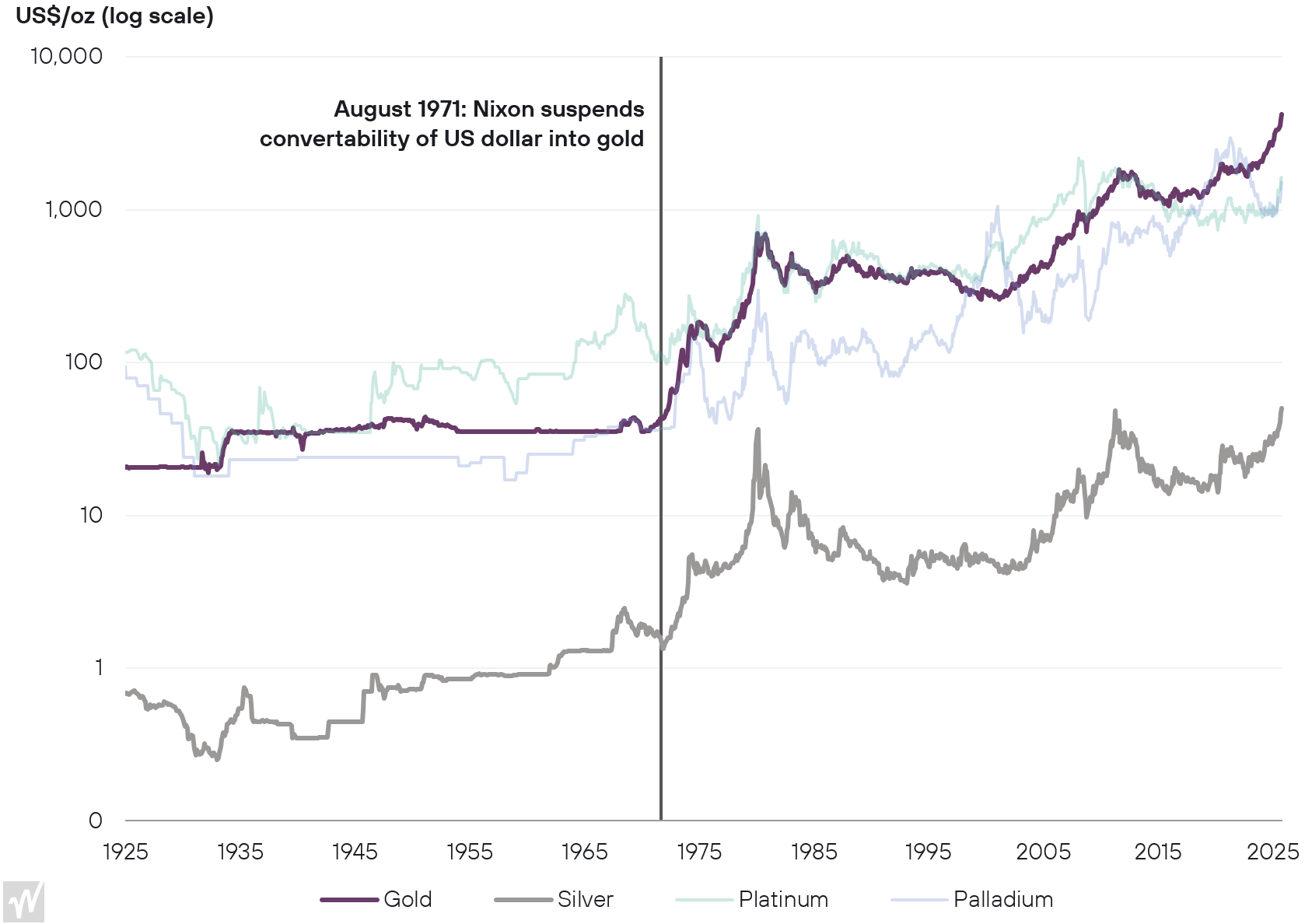
Sources: Gold: Quin's Metal Handbook London price (1925–1940), COMEX futures price (1941–present); Silver: Commodity Research Bureau London and New York prices (1925–June 1963), COMEX futures price (July 1963–present); Platinum: Commodity Research Bureau New York producer price (1925–1963), NYMEX futures price (1964–present); Palladium: Commodity Research Bureau New York dealer price (1925–1976), NYMEX futures price (1977–present). Data as at October 17, 2025. Shown for illustrative purposes only.
Price charts are often plotted on a linear scale, which makes recent moves look more dramatic than historical ones; the chart above uses a logarithmic scale. Gold has rallied 60% year-to-date, yet it rose 47%, 67%, and 73% in 1972, 1973, and 1974, respectively, and 136% in 1979 – a sixteen-fold increase in total between August 1971 and January 1980. The market has moved a long way this year, but history offers precedent for larger moves in both directions.
The challenge of holding gold for the long run
The rally to new highs may appear to vindicate a permanent gold allocation, but such an investment has historically been difficult to hold. Deep and sustained drawdowns – extended periods when prices sit far below their previous peak – have been a recurring feature of gold investing since 1971, even before accounting for inflation and the costs of maintaining a position.
Trend-following strategies approach markets like gold differently from a buy-and-hold allocation. They are designed to participate in uptrends while they persist, then cut exposure – and potentially position short – when trends reverse. That flexibility is intended to matter most in markets that, despite a long upward drift, have also seen sustained periods of sideways trading or decline. There is no guarantee, however, that a strategy will capture any particular trend or avoid losses when prices turn.
Managing risk as volatility rises
Unlike discretionary approaches, trend-following strategies do not attempt to predict what happens next in any given market. They adapt their positions in response to the latest price data, based on relationships observed in historical markets.
A key risk-management feature is that many trend-following strategies size positions inversely to volatility – an approach identified by Winton's founder David Harding and his previous firm in 1989 that has since become standard industry practice. When a market becomes more volatile, the strategy holds a smaller position for the same trend signal. Gold's volatility has been elevated since the tariff announcements in early April (see chart below), meaning that – contrary to some commentary suggesting trend followers are "max long" gold – this mechanism would, all else equal, imply smaller positions than when volatility was lower earlier in the year.
Have the trends run too far?
No one knows how far the trends in precious metals will extend or when they will end, and trend-following strategies will inevitably give back some gains when trends finally reverse. What these strategies offer is not a forecast but a disciplined, rules-based process: participating in trends while they persist, adjusting position sizes as risk changes, and responding systematically when markets turn. Understanding that process – including its limitations – is central to understanding the role such strategies might play in a portfolio.
Important information
This material is provided for informational and educational purposes only and does not constitute investment advice, a recommendation, or an offer or solicitation to buy or sell any security or to adopt any investment strategy. It is not intended to predict the performance of any investment and does not relate to any specific investment strategy or product that Winton offers.
All investing involves risk, including the possible loss of principal. Trend-following strategies invest in futures and other derivative instruments, which involve additional risks, including leverage, liquidity, and counterparty risk, and may be volatile. Investments in commodities and precious metals can be highly volatile. There is no guarantee that any trend-following strategy will correctly identify market trends, avoid losses when trends reverse, or achieve its objectives. Diversification does not ensure a profit or protect against loss in declining markets.
The opinions expressed are those of the author as of the date of publication, are subject to change without notice, and may not be shared by all personnel of Winton. Certain statements contained herein are forward-looking in nature and involve known and unknown risks and uncertainties; actual events or results may differ materially. Third-party data is believed to be reliable, but its accuracy and completeness are not guaranteed.
References to specific markets, prices, or historical episodes are for illustrative purposes only and do not represent the performance of any Winton fund or strategy. Past performance is not indicative of future results.


