Large moves in oil prices have historically rippled across the major asset classes. Trend-following strategies are designed to identify and adapt to these kinds of sustained market moves.
What is trend following?
Trend-following strategies use computer-driven models to respond to price trends across global markets – commodities, currencies, bonds, and stock indices – rather than trying to predict prices from economic forecasts. They seek long positions in markets that have been rising and short positions in markets that have been falling, reducing or exiting positions as trends reverse. This gives them return patterns that tend to differ from traditional stock and bond portfolios, along with distinct risks: abrupt reversals and choppy, sideways markets are typically difficult environments.
How trend followers approached the oil rally
Trend-following signals turned positive on oil in January as a rally in crude gathered strength. By the time Middle East tensions escalated in late February, many trend-following strategies were already positioned for rising prices – before crude climbed from around $65 per barrel to more than $100. These strategies did not predict the geopolitical events; they responded to price information as it emerged.
Prices versus forecasts
Before late February, most bank strategists and macroeconomists surveyed by Bloomberg predicted year-end oil prices of $55 to $70. With supply from the Middle East now highly uncertain, those forecasters project a far wider range of outcomes (see Figure 1). Yet most forecasts remain anchored to recent spot prices, with the majority still expecting oil to decline by year-end – much as forecasters through 2014 and 2015 expected a rebound, in the opposite direction, after oil collapsed amid the US shale boom.
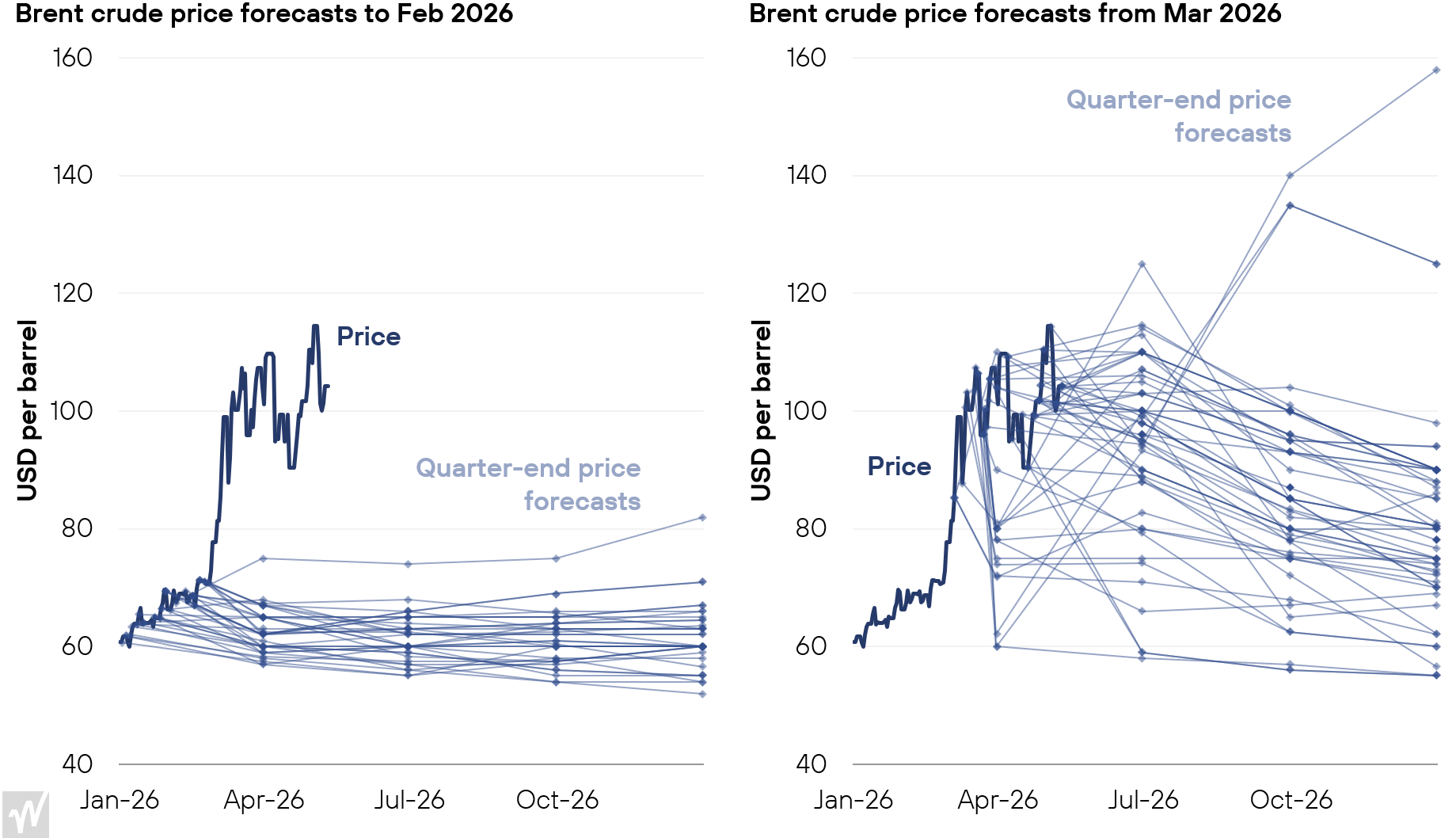
Figure 1: Bank strategist and macroeconomist oil price forecasts for 2026. Source: Bloomberg, as at May 12, 2026. Quarter-end forecasts collected by Bloomberg. Lines start at the date each forecast was published. Forecasts are shown for illustrative purposes only and are not predictions of actual results.
History suggests that once large oil price trends become established, they can persist for longer than forecasts anticipate – and the recent upswing is modest by historical standards. Figure 2 plots oil prices back more than 160 years on a logarithmic scale. Prices rose fivefold from their 2020 Covid lows, 11 times during the commodity supercycle of the 2000s, and 11-fold between 1973 and 1980 amid the Yom Kippur War and Iranian Revolution – an episode with some similarities to today.
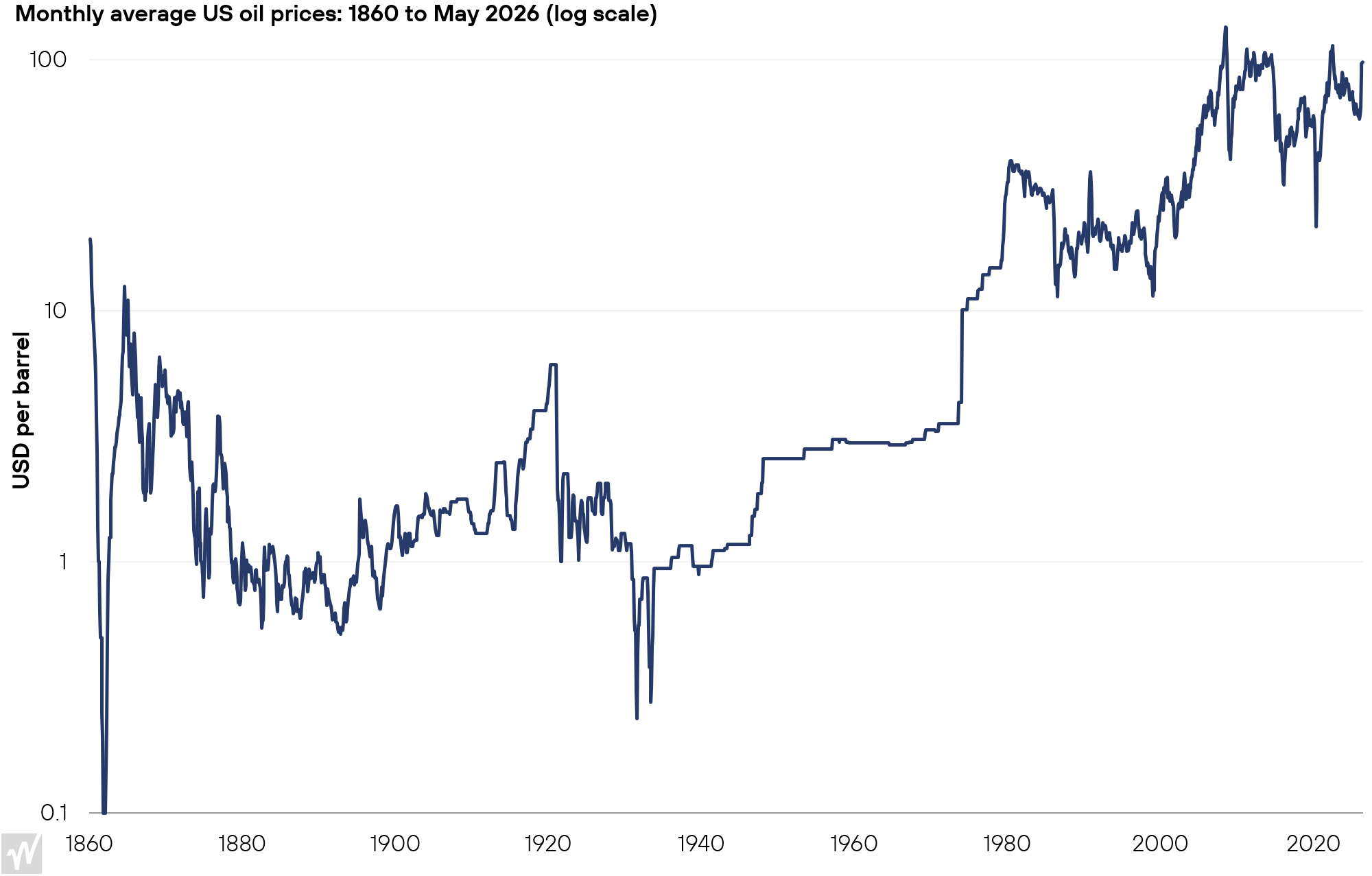
Figure 2: The recent rally in oil is small relative to historical price swings. Sources: The Derrick's Hand-Book of Petroleum (Pennsylvania price): 1860–1919; National Bureau of Economic Research (Pennsylvania price): 1920; Survey of Current Business (Kansas-Oklahoma price): 1921–1942; Platt's Oil Price Handbook (West Central Texas price): 1943–1945; Federal Reserve Bank of St. Louis (West Texas Intermediate spot price): 1946–March 1983; Bloomberg (front-month WTI crude futures): April 1983–May 12, 2026. Historical price movements are not indicative of future price behavior.
Why oil matters beyond oil
Oil prices feed into inflation expectations, which influence interest rates, bond yields, and the discount rates used to value stocks. Countries' differing exposures to oil can also drive divergent policy responses and currency moves. These cross-asset effects can produce sustained trends across many markets at once – the conditions trend-following strategies are designed for, since they typically trade a broad range of markets, long or short. There is no assurance, however, that any strategy will identify or profit from such trends, and broad positioning can also mean losses across multiple markets when trends reverse.
Responding to prices in uncertain times
In periods of geopolitical stress, market prices may incorporate new information more quickly than traditional macroeconomic forecasts. By responding systematically to price trends rather than attempting to predict fundamentally uncertain outcomes, trend-following strategies take a distinctive approach – one that has historically caused their returns to behave differently from traditional asset classes. Understanding this behavior is central to understanding what role, if any, such strategies might play in a broader portfolio.
Important information
This material is provided for informational and educational purposes only and does not constitute investment advice, a recommendation, or an offer or solicitation to buy or sell any security or to adopt any investment strategy. It is not intended to predict the performance of any investment.
All investing involves risk, including the possible loss of principal. Trend-following strategies invest in futures and other derivative instruments, which involve additional risks, including leverage, liquidity, and counterparty risk, and may be volatile. There is no guarantee that any trend-following strategy will correctly identify market trends, avoid losses when trends reverse, or achieve its objectives. Diversification does not ensure a profit or protect against loss in declining markets.
The opinions expressed are those of the author as of the date of publication, are subject to change without notice, and may not be shared by all personnel of Winton. Certain statements contained herein are forward-looking in nature and involve known and unknown risks and uncertainties; actual events or results may differ materially. Third-party data is believed to be reliable, but its accuracy and completeness are not guaranteed.
References to specific markets, prices, or historical episodes are for illustrative purposes only and do not represent the performance of any Winton fund or strategy. Past performance is not indicative of future results.


