Some investors worried that rapid policy shifts would undermine trend-following strategies. History does not show a link between who is in the White House and how the strategy performs.
A common concern
In early 2025, a common view was that trend following could not work while the US president frequently announced, paused, or reversed market-moving policies, often on social media. Trend-following strategies had been through a muted stretch since April 2024. The "Liberation Day" tariff announcements in April 2025 then triggered sharp price reversals across several asset classes, extending a difficult period for the strategy.
Trend-following strategies use computer-driven models to take long positions in rising markets and short positions in falling ones. Abrupt reversals of this kind are typically among the most challenging environments for them.
What the record shows
Industry performance under President Trump does not look different from performance under his predecessors. Through October 21, 2026, results during his second term, and during the second year of that term, sit toward the upper end of what has been seen historically at the same point in a presidential term.
An investor who reduced exposure at the end of April 2025, expecting the strategy to struggle in a policy-driven environment, would have missed a recovery of roughly 30% in industry performance, as measured by the SG Trend Index.
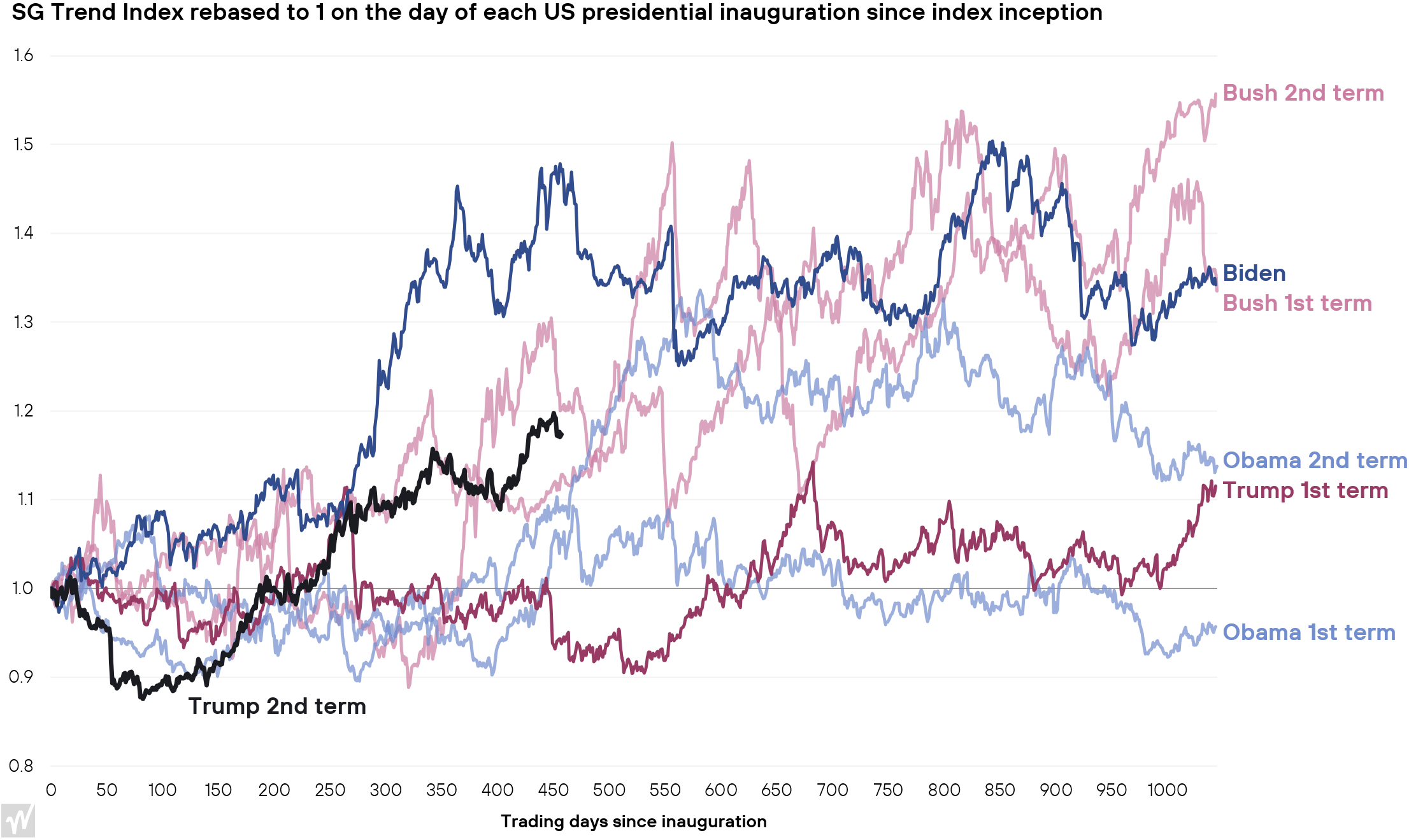
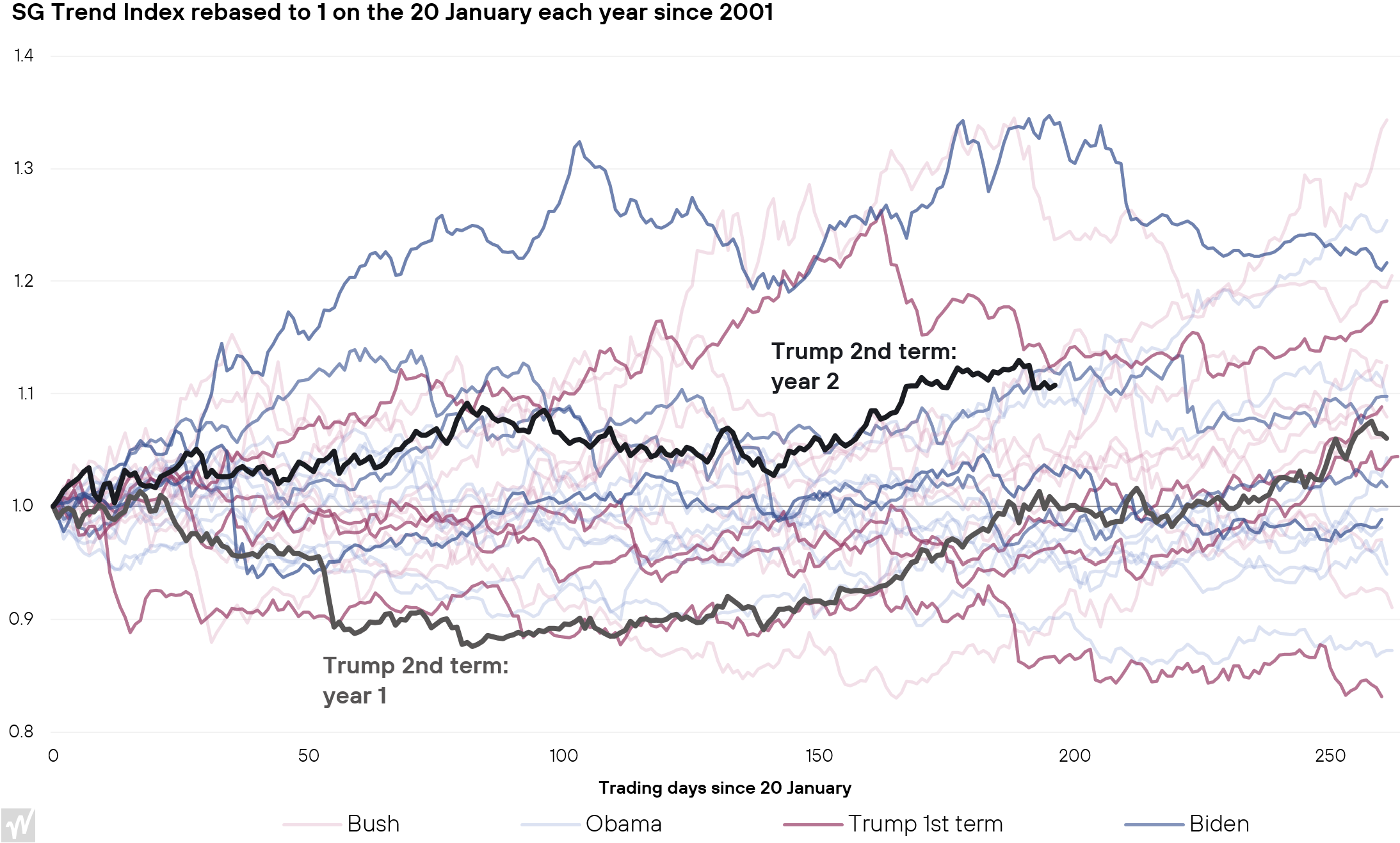
Figure 1: Trend following through each presidential term (top) and presidential term year (bottom). Source: Societe Generale, as at October 21, 2026. The SG Trend Index reflects the performance of the 10 largest trend-following managers open to new investment. Further information on the index’s methodology is available on Societe Generale’s website. Past performance is not indicative of future results.
The difficulty of timing
Trying to time exposure to trend following around a particular "market environment" is hard because trends often emerge unexpectedly. A favorable environment for the strategy is usually obvious only in hindsight.
Winton's research has found that investing only during periods typically associated with strong trend-following performance has not improved on maintaining a steady allocation throughout. Attempting to time the strategy also risks undermining the main reason investors consider it: its returns have historically tended to behave differently from those of traditional stocks and bonds.
Prices, not politics
Trend-following strategies do not attempt to forecast policy decisions or their market consequences. They respond systematically to price trends as they emerge, whatever their cause, whether tariffs, interest rate changes, or geopolitical events. There is no guarantee that any strategy will identify or profit from such trends, and periods of sharp reversals can lead to losses. Understanding this process, including its limitations, is central to understanding what role, if any, such strategies might play in a portfolio.
Important information
This material is provided for informational and educational purposes only and does not constitute investment advice, a recommendation, or an offer or solicitation to buy or sell any security or to adopt any investment strategy. It is not intended to predict the performance of any investment.
All investing involves risk, including the possible loss of principal. Trend-following strategies invest in futures and other derivative instruments, which involve additional risks, including leverage, liquidity, and counterparty risk, and may be volatile. There is no guarantee that any trend-following strategy will correctly identify market trends, avoid losses when trends reverse, or achieve its objectives. Diversification does not ensure a profit or protect against loss in declining markets.
The opinions expressed are those of the author as of the date of publication, are subject to change without notice, and may not be shared by all personnel of Winton. Certain statements contained herein are forward-looking in nature and involve known and unknown risks and uncertainties; actual events or results may differ materially. Third-party data is believed to be reliable, but its accuracy and completeness are not guaranteed.
References to specific markets, prices, or historical episodes are for illustrative purposes only and do not represent the performance of any Winton fund or strategy. Past performance is not indicative of future results.


